
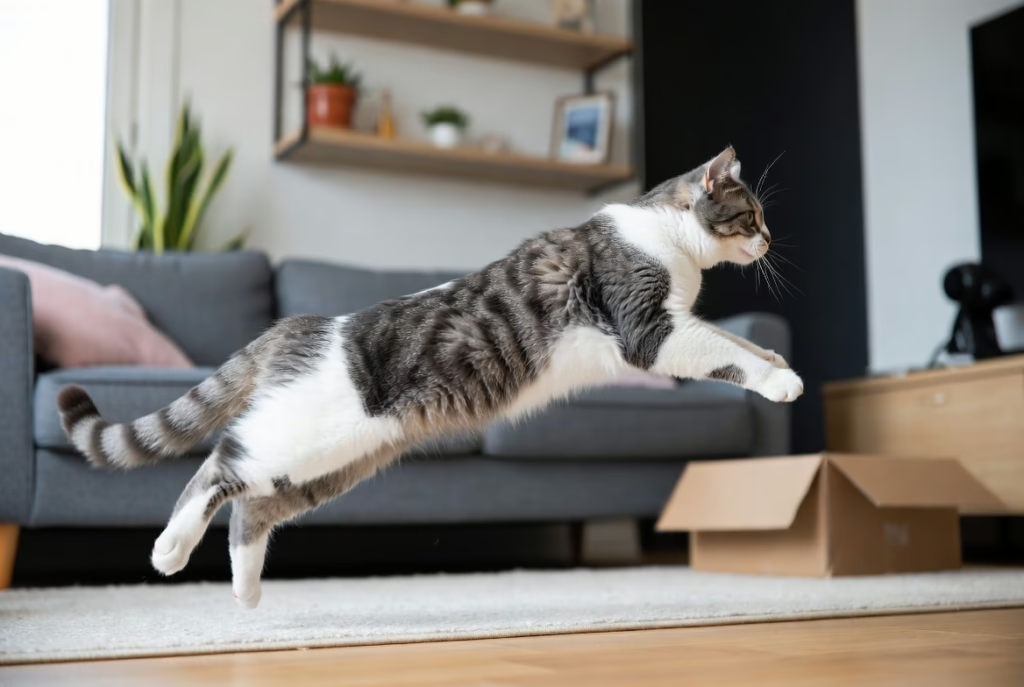
Your cat just folded herself into a shoebox half her size, then leaped six feet straight up from a standstill. How? The answer’s written into every bone, muscle, and whisker. Think of cats as evolutionary masterpieces—predators refined over millions of years into compact, efficient hunting machines. We’re about to explore exactly what’s under all that fur.
External Cat Body Parts and Their Functions
Every visible part of your cat tells a survival story.
Take those ears—each one packs in 32 separate muscles. While your head needs to turn for better hearing, cat ears rotate independently through nearly 180 degrees. The pinna (that’s the triangular flap everyone recognizes) channels sound inward like a funnel. Here’s the impressive bit: while human hearing cuts out around 20,000 Hz, cats pick up frequencies reaching 32,000 Hz. Those ultrasonic mouse squeaks you miss completely? Your cat hears them crystal clear.
Whiskers do way more than add to the cute factor. Called vibrissae by scientists, these specialized hairs sprout from the muzzle, eyebrow area, and front legs. Each whisker root connects to a cluster of nerve endings that register microscopic changes in air currents. The width of a cat’s whisker spread typically matches their body width. About to enter a narrow space? Those whiskers contact the edges first, sending immediate feedback about clearance. Damage or trim them, and cats struggle with spatial judgment until they grow back.
Paws combine shock absorption with stealth technology. Front paws carry five toes each; rear paws have four. The main pad plus individual toe pads spread weight distribution during landings. Hidden between those pads are scent glands—every scratch session leaves a chemical signature claiming territory.
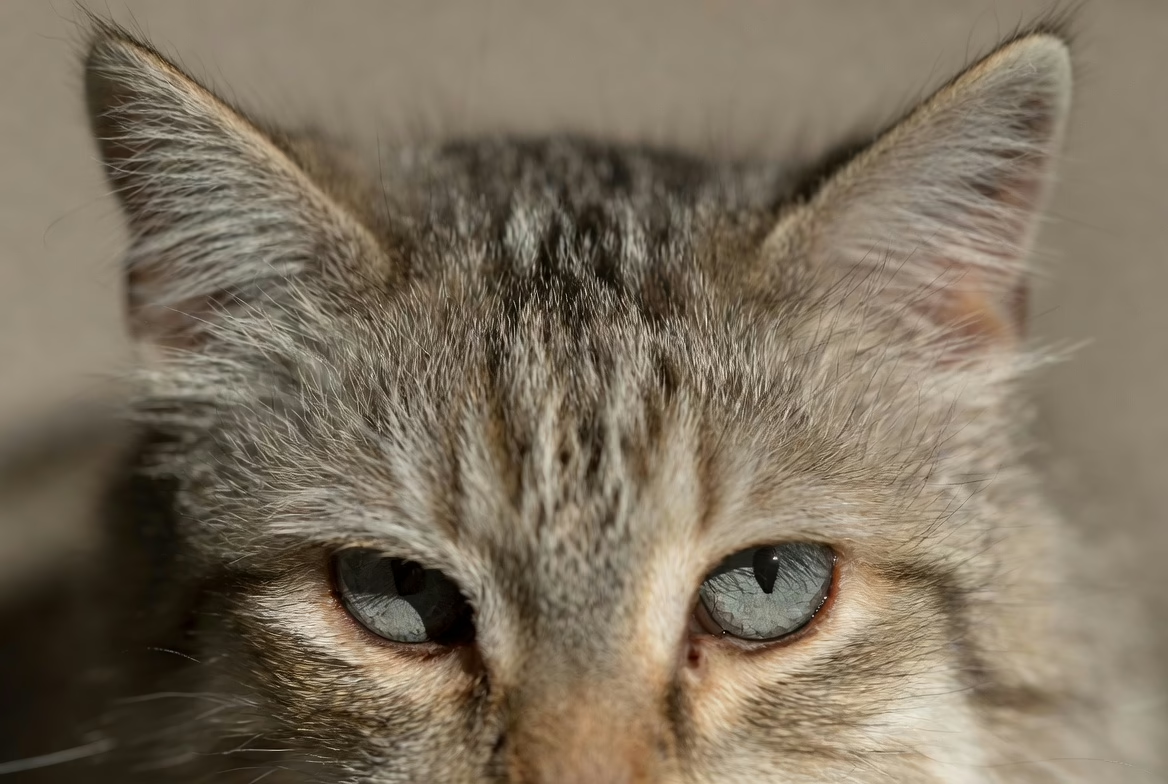
Eyes position up front rather than on the sides, creating significant overlap between what each eye sees. This binocular vision helps cats judge distances accurately—critical when you’re calculating pounce trajectories. Behind the retina lies a structure called the tapetum lucidum, which reflects incoming light back through the photoreceptor cells for a second pass. This creates that eerie glow when light hits cat eyes at night. Cats also have a third eyelid (the nictitating membrane) that sweeps horizontally across the eyeball for cleaning and protection.
Tail vertebrae number anywhere from 19 to 23, surrounded by muscles offering precise control. Balance matters, sure, but tails primarily communicate. A vertical tail with a question-mark curve at the tip? Your cat’s saying hello. That puffed-up Halloween-cat tail signals serious alarm. Breeds like the Manx, born without tails, develop stronger hind leg muscles to compensate.
The nose varies in texture and color between individual cats. Inside that small nose sit approximately 200 million scent receptors—humans have maybe 5 million for comparison. Behind the front teeth, tucked into the mouth’s ceiling, sits Jacobson’s organ—a secondary scent analyzer that picks up chemical signals regular nostrils can’t detect. That strange open-mouthed grimace after sniffing something interesting? That’s the flehmen response, where they’re drawing air across this specialized detector.
Cat Skeleton Structure and Bone Count
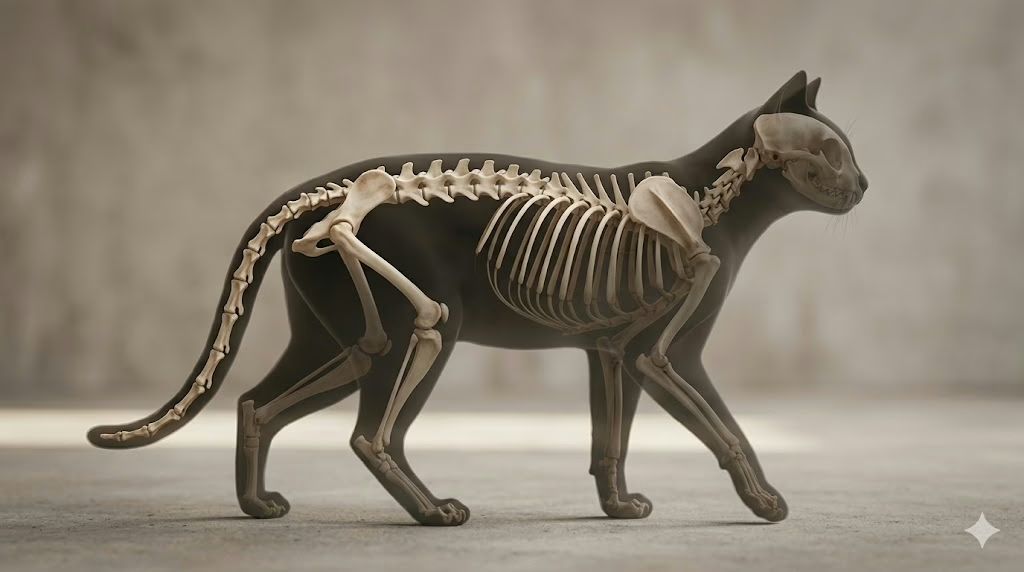
The average adult cat skeleton contains roughly 244 bones, though individual tail length shifts this total by several bones. Humans carry 206, but direct comparisons miss the point—our skeletons solve completely different engineering problems.
Count the vertebrae in a cat’s backbone and you’ll hit about 53: seven in the neck, thirteen through the chest, seven in the lower back, three fused pieces forming the pelvis anchor point, and between 20 and 23 making up the tail. Elastic cartilage cushions sit between each bone segment. The connecting joints allow unusual freedom of movement. This setup lets cats rotate their spine beyond 180 degrees and compress their entire body profile to squeeze through absurdly small openings.
Skull anatomy features large forward-facing eye sockets, shortened nasal passages, and powerful jaw attachment sites. The jaw articulates in a simple hinge—cats move their jaws up and down exclusively, without the side-to-side grinding motion herbivores use. The rounded skull shape protects the brain while accommodating proportionally enormous eyes.
Back legs contain significantly longer bones than the front legs, which sets up that characteristic stalking crouch and provides the explosive power for those impressive jumps. Here’s something weird: cats essentially lack functional collarbones. Their clavicle exists as a tiny free-floating bone embedded in shoulder muscle tissue. Without a solid collarbone anchoring shoulder blades to the chest, the shoulders slide independently along the ribcage. This allows cats to narrow their chest width when threading through tight spaces.
Front paws contain metacarpal bones while rear paws house metatarsals, and both connect forward to the toe bones scientists call phalanges. Most toes contain three bone segments, except the dewclaw with only two. The final toe bone houses the claw and pivots backward when retracted, tucking into a protective skin sheath.
| Skeletal Feature | Cats | Humans |
|---|---|---|
| Overall bone count | Approximately 244 | 206 |
| Total vertebrae | Close to 53 | 33 |
| Collarbone function | Tiny floating fragment in shoulder muscle | Fully developed, connects shoulder to sternum |
| Tail vertebrae | Between 20-23 | 3-5 (merged into coccyx) |
| Toe bone count (front/rear) | 18 in front paws, 16 in rear | 28 combined (hands and feet) |
Internal Cat Organs Explained
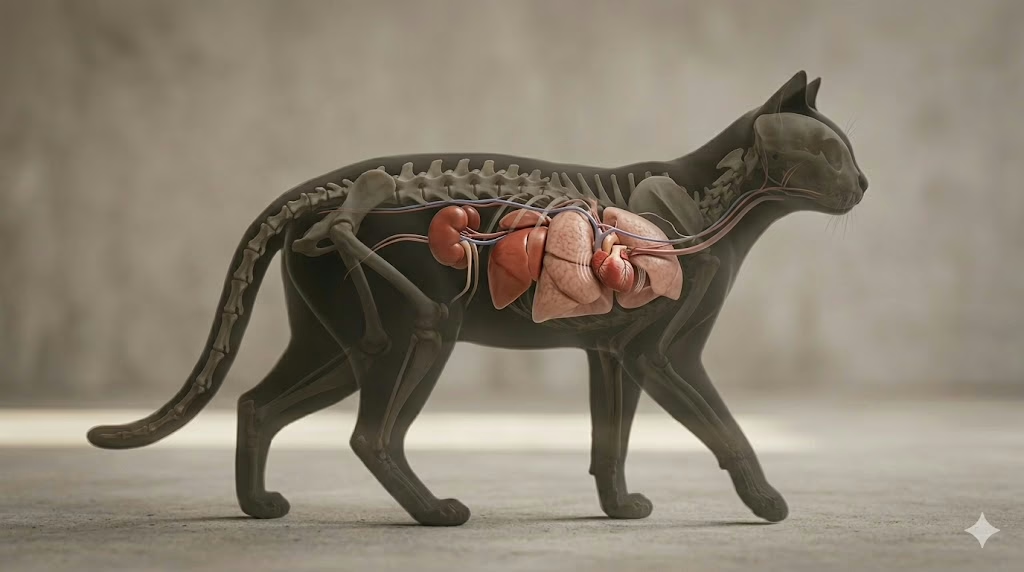
Packed inside the ribcage and abdomen, internal organs handle the extreme metabolic demands obligate carnivores face. Space efficiency matters when you’re built for agility.
The heart sits between ribs four and six, angled slightly toward the left side. Normal heart rates in healthy cats range from 140 to 220 beats per minute—roughly double human resting rates. Blood flows through four distinct chambers: two atria that receive incoming blood, two ventricles that pump it out. The aorta (your body’s largest artery) exits directly from the left ventricle.
Lungs occupy both sides of the chest cavity flanking the heart. The right lung divides into four lobes; the left has two. The diaphragm—that muscular partition separating chest from abdomen—contracts rhythmically to draw air inward. When relaxed, normal feline respiration ranges from 20 to 30 breaths every minute.
Two bean-shaped kidneys sit in the upper abdomen, with the right one positioned slightly forward compared to the left. They continuously scrub waste products from blood while keeping fluid levels balanced. Cats concentrate urine remarkably well—an adaptation inherited from desert-dwelling ancestors who couldn’t waste water. Each kidney houses approximately one million nephrons, the microscopic filtering units performing the actual purification work.
The liver occupies the front portion of the abdomen, divided into six lobes. It processes nutrients absorbed from intestines, manufactures bile for breaking down fats, and neutralizes toxic substances. Cat livers lack specific enzymes that metabolize certain medications like acetaminophen. Substances safe for humans can prove lethal to cats.
Positioned near the stomach, the spleen maintains a reserve supply of red blood cells and filters worn-out ones from the bloodstream. It plays a supporting role in keeping the immune system running smoothly.
Digestive System Overview
The complete digestive tract measures approximately 1.2 meters in adult cats. The journey starts at the mouth, where 30 permanent teeth (12 incisors, 4 canines, 10 premolars, 4 molars) tear and slice meat. Notice something missing? Cats completely lack flat grinding molars—their dentition cuts and shears exclusively.
From mouth to stomach, the esophagus uses rhythmic muscle waves called peristalsis to move food downward—gravity alone won’t cut it when you’re eating upside down or sideways like cats often do. The stomach secretes hydrochloric acid and protein-digesting enzymes. Stomach pH drops between 1 and 2—acidic enough to soften small bones from prey animals.
Stretching roughly one meter, the small intestine absorbs most nutrients from digested food. Its inner lining bristles with millions of villi—microscopic finger-shaped projections that multiply available surface area. The pancreas releases digestive enzymes into this section. Bile from the gallbladder gets stored and released here, though here’s a fun fact: some cats are born without gallbladders and live perfectly normal lives.
The large intestine (colon) reclaims water and consolidates waste material. It’s proportionally shorter than in omnivorous animals because protein-heavy diets require less fermentation time. Food typically takes 12 to 24 hours traveling from mouth to litter box.
Respiratory and Circulatory Systems
Inhaled air travels through the nose or mouth, slides past the larynx where meowing happens, then flows down into the trachea. This windpipe splits into two bronchi, which keep branching into progressively smaller bronchioles within the lungs. At the bronchioles’ terminal ends sit alveoli—microscopic air sacs where oxygen and carbon dioxide exchange places with blood.
Blood follows two distinct loops. The pulmonary circuit transports oxygen-depleted blood from the heart’s right side to the lungs for oxygen replenishment, then returns to the heart’s left side. The systemic circuit distributes this oxygen-rich blood throughout the entire body before returning depleted blood to the heart’s right chambers.
Cats carry more blood relative to body weight than humans—approximately 66 to 77 milliliters per kilogram versus our 65 to 70 ml/kg. This higher blood volume fuels those intense hunting bursts.
The cat’s spine contains more vertebrae than nearly any other mammal of comparable size, and the elastic cushioning between each bone creates a flexibility that’s essentially a built-in shock absorption system. This is why cats can fall from significant heights and walk away—their skeletal structure dissipates impact forces that would injure animals with more rigid spines.
Dr. Jennifer Coates
Unique Cat Physical Traits
Several anatomical features distinguish cats from other carnivores and most mammals generally.
Retractable claws rest inside protective skin pockets by default. Elastic ligaments hold them there passively—no muscular effort required. When cats extend their claws, flexor tendons contract, pulling the terminal toe bone forward and downward. This keeps claws perpetually sharp because they avoid ground contact during normal walking. Cheetahs represent the oddball exception within the cat family, possessing only semi-retractable claws that provide traction for high-speed pursuits.
Night vision results from multiple adaptations working in concert. The retina concentrates rod cells (low-light sensors) and functions in light conditions one-sixth as dim as humans require. The elliptical pupil dilates extremely wide, maximizing light capture. The tradeoff? Reduced color perception. Cats distinguish blues and greens reasonably well but perceive reds and pinks as greenish-gray tones.
The backbone’s flexibility comes from loose connections between vertebral segments plus those elastic discs cushioning each joint. This enables a running gait called “double suspension gallop.” The spine rhythmically extends and compresses, effectively lengthening each stride. During full sprints, all four feet leave the ground twice per stride—once with spine stretched, once compressed.
Specialized teeth include prominent canines measuring up to 1.5 centimeters in adults. These fangs slot into gaps (diastema) in the opposing jaw for complete bite closure. Carnassial teeth—specifically the fourth upper premolar paired with the first lower molar—function like scissors, shearing meat from bones. These teeth meet with precision when jaws close, slicing rather than crushing.
Hearing range extends from 48 Hz up to 85 kHz, detecting ultrasonic squeaks emitted by rodent prey. The cone-shaped pinnae amplify incoming sounds. Independent ear rotation helps triangulate sound sources to within three inches at one yard distance.
Jacobson’s organ (vomeronasal organ) consists of two fluid-filled sacs positioned in the mouth’s roof, opening behind the upper incisors. When cats curl their lips and part their jaws slightly (flehmen response), they draw air across this specialized organ. It analyzes pheromones and chemical signals that standard olfactory receptors can’t detect.
How Cat Anatomy Supports Hunting Behavior
Every anatomical feature connects directly to predatory function. Cats rely on ambush tactics, built for explosive bursts rather than sustained chases.
Muscle structure comprises approximately 500 individual muscles. Powerful hind leg muscles generate jumping force reaching six times body length. Fast-twitch muscle fibers dominate the composition, enabling rapid acceleration but fatiguing quickly. This explains why cats hunt in brief intense efforts rather than prolonged pursuits.
Skeletal design permits extraordinary rotation and body compression. That vestigial clavicle allows shoulder blades to glide closer together, narrowing body profile when stalking through vegetation. The flexible spine extends stride length mid-chase and absorbs landing shock following pounces.
Sensory organs coordinate seamlessly. Forward-facing eyes provide a 200-degree total field of view, including 140 degrees of binocular overlap for accurate depth perception when calculating pounce distance. Whiskers register air movement from prey, functioning even in complete darkness. Ears pinpoint rustling sounds within a few degrees of accuracy.
Thick toe pads muffle footfalls while cats stalk. Retracted claws prevent clicking on hard surfaces. Sweat glands in paw pads provide minimal moisture for grip without leaving heavy scent trails that might alert prey.
Dental arrangement delivers the killing bite. Long canines pierce between prey vertebrae, severing the spinal cord. The narrow jaw and reduced tooth count (versus dogs’ 42 teeth) creates concentrated bite force per tooth. Rough tongue papillae, constructed from keratin, efficiently scrape meat from bones.
Cardiovascular capacity supports brief intense exertion. The enlarged heart relative to body size plus elevated blood volume delivers oxygen rapidly to working muscles. However, cats lack the sustained endurance of pursuit predators—most hunting sequences conclude within 60 seconds.
FAQs
Most adult cats carry around 244 bones, though the exact number shifts depending on tail length—longer tails mean more vertebrae. Kittens actually start life with over 300 bones, many of which fuse together during maturation. The higher count compared to humans (206 bones) stems primarily from their elongated spine and tail structure.
Six times less light than you need? That’s all a cat requires, thanks to layered evolutionary tricks. Rod cells (which detect movement and shapes in dim conditions) dominate their retinas, while color-detecting cone cells take a back seat. The tapetum lucidum positioned behind the retina bounces light back through photoreceptors again, essentially allowing a second detection opportunity. Pupils dilate extremely wide to capture maximum available light. Still, complete darkness defeats even cats—they need some minimal light source to navigate.
Cats carry approximately 53 vertebrae compared to our 33, with elastic discs cushioning between each segment. The vertebral joints permit significantly more rotation than most mammalian spines allow. Combine this with the absent functional clavicle—their shoulder blades move independently rather than locking to the ribcage—and you get the extreme twisting, compressing, and extending cats demonstrate when threading through confined spaces or executing mid-air acrobatics.
Most cats fully retract their claws, but cheetahs break this pattern within the Felidae family. Cheetah claws only partially retract, remaining somewhat exposed to provide traction during high-speed chases—functioning more like canine claws. Domestic cats and other felids keep claws completely sheathed when relaxed, extending them only for climbing, hunting, or defense. Retraction prevents wear and maintains sharpness.
As true carnivores, cats sport shorter intestinal tracts designed specifically for animal protein—their small intestine stretches about one meter compared to the 1.8 to 2.5 meters you’d find in similar-sized dogs. Cats produce less amylase (the carbohydrate-busting enzyme) and must obtain certain nutrients like taurine, vitamin A, and arachidonic acid directly from animal tissue. They can’t manufacture these compounds from plant sources like dogs manage. Cat stomach acid runs more concentrated too, capable of softening small bones.
Whiskers (vibrissae) function as sophisticated sensory instruments. Each whisker occupies a follicle ringed with nerve endings and proprioceptors detecting minute movements. Whiskers register air current changes, helping cats navigate darkness and detect nearby objects without physical contact. Whisker span typically matches body width, allowing cats to gauge whether openings accommodate passage. Whiskers also broadcast emotional state—forward-facing signals interest or aggression, while flattened backward indicates fear or submission.
Cat anatomy showcases evolutionary refinement focused on a specialized lifestyle. Those roughly 244 bones arranged for flexibility, sensory organs calibrated for hunting—every structure serves distinct functions. The skeletal framework balances strength with elasticity, permitting dramatic physical feats. Internal organs support high-energy demands from carnivorous diets while maintaining compact profiles.
External features like whiskers, retractable claws, and independently rotating ears demonstrate form following function. Understanding these anatomical elements explains not just how cats move and hunt, but why they behave as they do. Whether you’re a pet owner monitoring your cat’s health, a student studying biology, or simply someone curious about these animals, recognizing connections between structure and behavior deepens appreciation for feline design.
The next time your cat compresses into an impossibly small cardboard box or sticks a perfect landing after leaping from the refrigerator top, you’ll understand the anatomical mechanisms making those actions possible. That’s not magic—that’s millions of years of evolutionary refinement compressed into one furry package.