
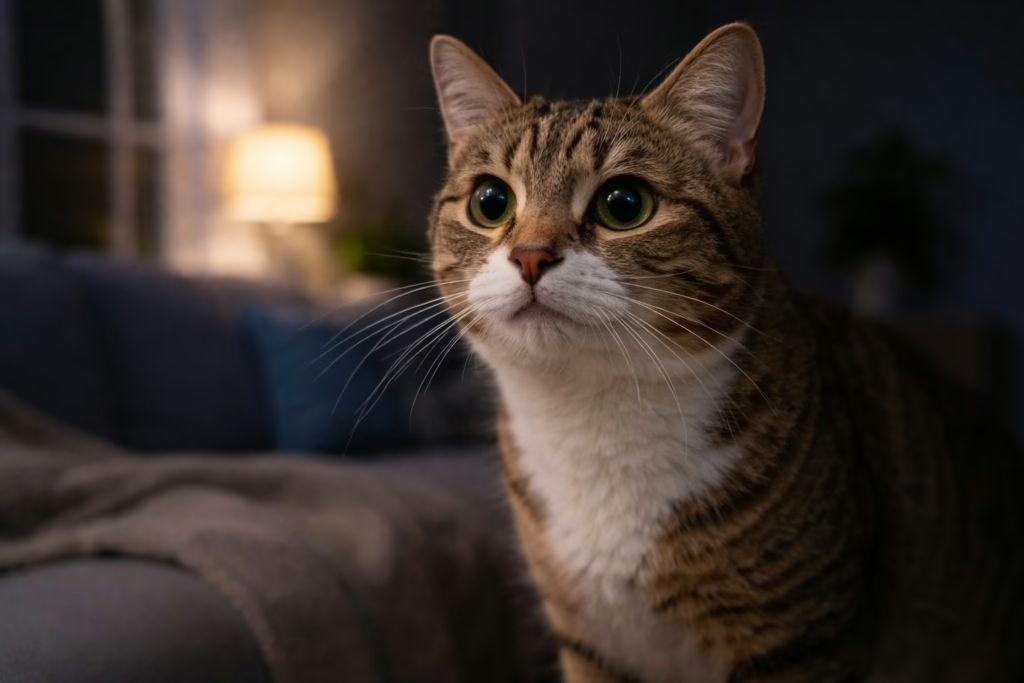
Have you ever watched your cat stare intently at a wall where you see absolutely nothing? That’s because feline eyes work completely differently from ours. While humans developed vision optimized for daytime detail and vibrant colors, cats evolved as twilight hunters. Their entire visual system trades sharpness and color variety for something more valuable to a predator: the ability to spot a mouse twitching in near-darkness at dusk.
How Cat Eyes Are Built for Hunting
Every part of a cat’s eye evolved to solve one problem: catching prey when light levels drop. Let’s break down the specialized equipment that makes this possible.
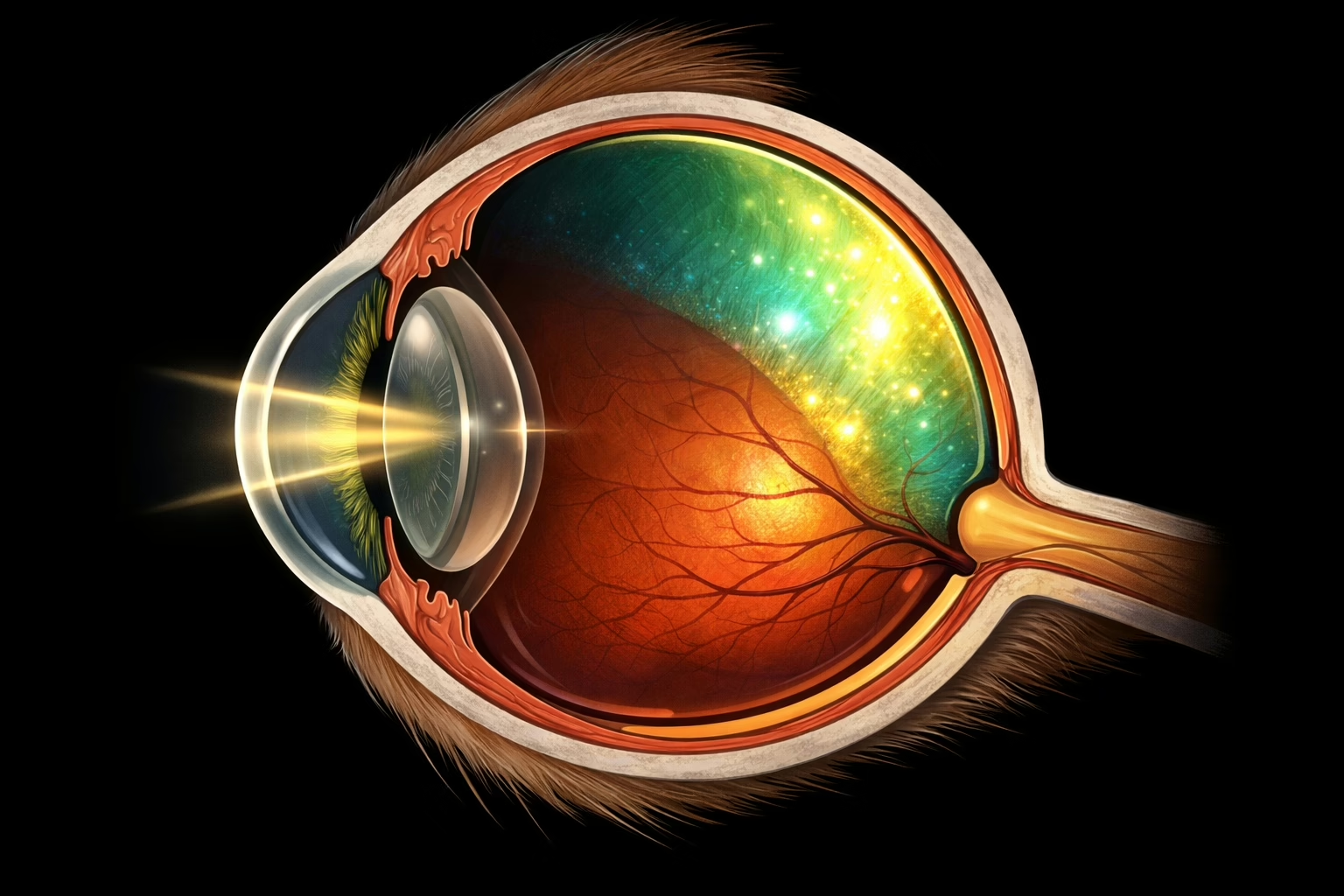
Behind the retina lies the tapetum lucidum—think of it as a biological mirror made of reflective cells. When light passes through the retina the first time, this layer reflects it straight back for a second pass. Any photons the photoreceptors missed on round one get another shot at detection. This reflective trick boosts available light by about 40% and creates that eerie glow you see when car headlights hit your cat’s face at night.
The rod-to-cone ratio in cat eyes is heavily skewed. Rods handle dim light and motion detection, while cones process color and fine detail. Cats pack their retinas with rods—about 25 for every single cone, versus humans at roughly 20:1. That extra rod density comes with trade-offs. Fewer cones mean washed-out colors and blurrier details in bright sunlight. But when twilight arrives? Cats can see using about one-sixth the illumination humans need for the same view.
Those distinctive vertical slit pupils aren’t just for show. Unlike our round pupils, these slits contract to razor-thin lines in bright conditions and balloon to nearly full iris width in darkness. This design gives cats incredibly precise control over incoming light—essential when you hunt from dawn to dusk across wildly different brightness levels. The slit shape also sharpens depth perception for targets straight ahead and reduces color distortion around image edges.
Relative to their head size, cats have enormous corneas and lenses. The cornea takes up more surface area than it does in human eyes, functioning like a wide-angle lens that captures maximum light. The oversized lens further amplifies light-gathering capacity. There’s a downside: the large, somewhat inflexible lens limits how well cats can adjust focus for different distances.
Cat eyes are slightly elliptical rather than spherical, which widens their horizontal field of view. Combined with forward-facing placement, this shape gives cats both broad peripheral awareness (for detecting danger) and binocular overlap (for calculating pounce distances accurately).
How Cats See Compared to Humans
When comparing cat vision vs human vision, remember that evolution optimizes for different survival needs. Cats don’t see “worse” than us—they see differently based on what matters for hunting.
Visual acuity measures how well you distinguish fine details. Humans score 20/20 as the baseline. Cats? They’re somewhere between 20/100 and 20/200. Translation: What you read clearly from 100 feet away, your cat needs to get within 20 feet to see equally well. Everything looks somewhat blurry to cats compared to human perception. But here’s the thing—when you’re hunting, spotting movement matters way more than reading fine print.
The feline field of view stretches about 200 degrees, giving them roughly 20 extra degrees compared to our 180-degree range. That peripheral coverage helps spot approaching threats or prey from the sides. The binocular zone where both eyes see the same space measures approximately 140 degrees in cats, delivering excellent depth perception for judging how far away that toy mouse really is.
What Colors Can Cats Actually See?
Cats have dichromatic vision—similar to humans with red-green colorblindness. They possess two cone types: one sensitive to blue-violet wavelengths (around 450-454 nm) and another tuned to yellow-green (540-561 nm). Blues and yellows come through fairly well. Reds, oranges, and most greens? These probably look like various shades of yellow, gray, or blue.
Imagine looking at a faded photograph where all the warm tones got replaced with muted browns and yellows. That red ball you bought? Your cat sees it as brownish-gray. The green grass outside? More like pale yellow. Purple and blue objects pop out most clearly. For hunting purposes, this limited palette doesn’t matter much since prey animals also see limited colors.

Do Cats See Better Up Close or Far Away?
Cats are moderately nearsighted. They focus best between 2-6 feet—which happens to be the perfect striking distance for pouncing on prey. Anything closer than 12 inches gets hard to focus on, which explains why cats use whiskers and their nose to investigate objects right in front of their face. Past 20 feet, everything blurs noticeably, though cats still pick up movement out to 50-60 feet.
This focusing range matches hunting behavior perfectly: scan for movement in the distance, stalk closer while keeping the target in view, then strike when prey enters that 2-6 foot sweet spot where everything’s crystal clear.
Why Cats Have Superior Night Vision
Under low-light conditions, cats out-see humans by a factor of 6-8 times. The exact advantage varies with ambient brightness, but multiple features work together to create this night vision superiority.
The tapetum lucidum forms the foundation. By bouncing light back through photoreceptors for a second chance at detection, it essentially doubles the effective light hitting the retina. Eyeshine color—typically green, gold, orange, or occasionally blue—depends on mineral composition in the tapetum layer. Each cat has its own signature color.
Rod cell dominance amplifies dim light sensitivity. Rods can detect photons at much lower thresholds than cones. With their rod-heavy retinas, cats operate effectively in light levels that leave humans stumbling in darkness.
Pupil dilation permits massive light entry when needed. The vertical slit expands dramatically—human pupils go from about 2mm to 8mm diameter, but relative to eye size, cat pupils expand from under 1mm to approximately 14mm. That’s a huge aperture difference.
Why cats see in dark conditions so well traces back to evolutionary pressure. Wild cat ancestors hunted primarily during twilight—dawn and dusk—when their prey was active but larger predators were less of a threat. This crepuscular lifestyle created selective pressure for enhanced low-light vision.
They’re not magical, though. Cats definitely cannot see in complete, total darkness—they still need some light source for the tapetum lucidum and rods to work with. Zero light means zero vision. Cats require roughly 0.125 lux (about the light from a single candle 30 feet away), while humans need 0.75 lux. In pitch-black conditions, cats rely on whiskers, hearing, and scent rather than eyes.
Cat Visual Range and Motion Detection
Feline eyesight range emphasizes breadth and movement tracking over distance clarity and detail sharpness. That 200-degree field of view provides almost panoramic awareness—useful both for hunting and avoiding becoming prey.
Peripheral vision reaches about 30 degrees past each side of the head compared to humans. This extra coverage lets cats monitor their flanks without head movement. However, peripheral acuity drops significantly—cats use these side zones to detect that something moved, then rotate their head to examine it with sharper central vision.
Distance vision handles movement detection adequately out to 50-60 feet, though fine details disappear beyond 20 feet. A mouse running 50 feet away gets noticed immediately. Text written on paper 8 feet away? Totally illegible, even if cats could read.
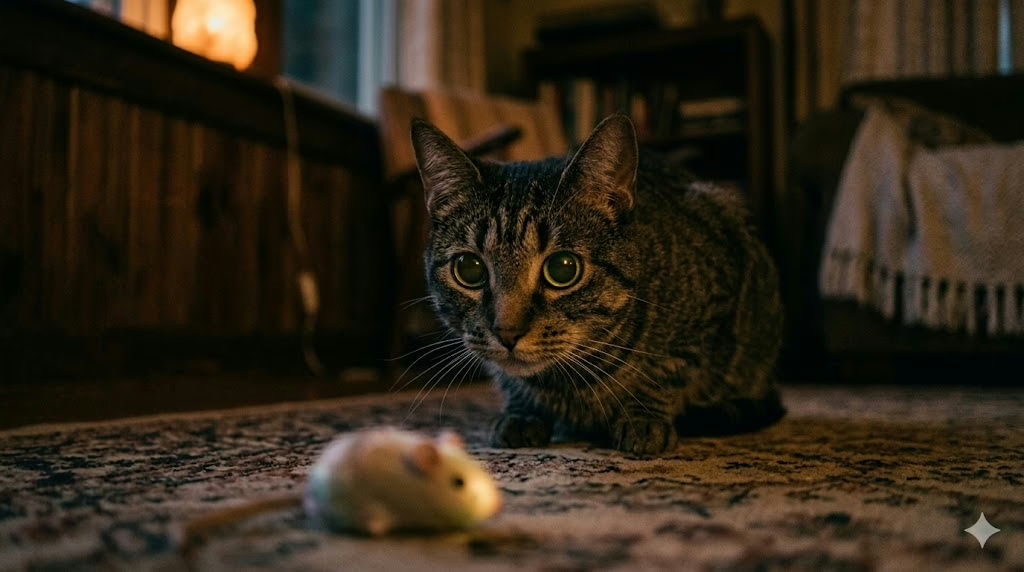
Motion sensitivity might be the most remarkable aspect of how cats see. They pick up subtle movements humans completely miss, especially under low light. High rod counts and neural processing optimized for motion detection mean that mouse twitch 40 feet away in dim conditions captures feline attention instantly.
Here’s the catch: stationary objects become nearly invisible to cats. A mouse that freezes completely might disappear from a cat’s perception, particularly beyond 15 feet. This explains why cats bat at suspected prey with their paws—creating movement makes the target visible again.
Tracking fast-moving objects works better horizontally than vertically. The elliptical eye shape and horizontal visual streak (a band of high-density photoreceptors running across the retina) evolved for tracking prey running along the ground, not birds flying overhead.
Common Myths About How Cats See
Several stubborn misconceptions about feline vision refuse to die despite clear scientific evidence.
Myth: Cats see perfectly in complete darkness. Wrong. Cats need at least minimal ambient light. In absolute zero darkness, they’re just as blind as humans. Superior night vision operates in low light, not absent light. Moonlight, starlight, or distant streetlamps provide enough illumination for cats to navigate confidently. A sealed, windowless room with no light source? No visual information available.
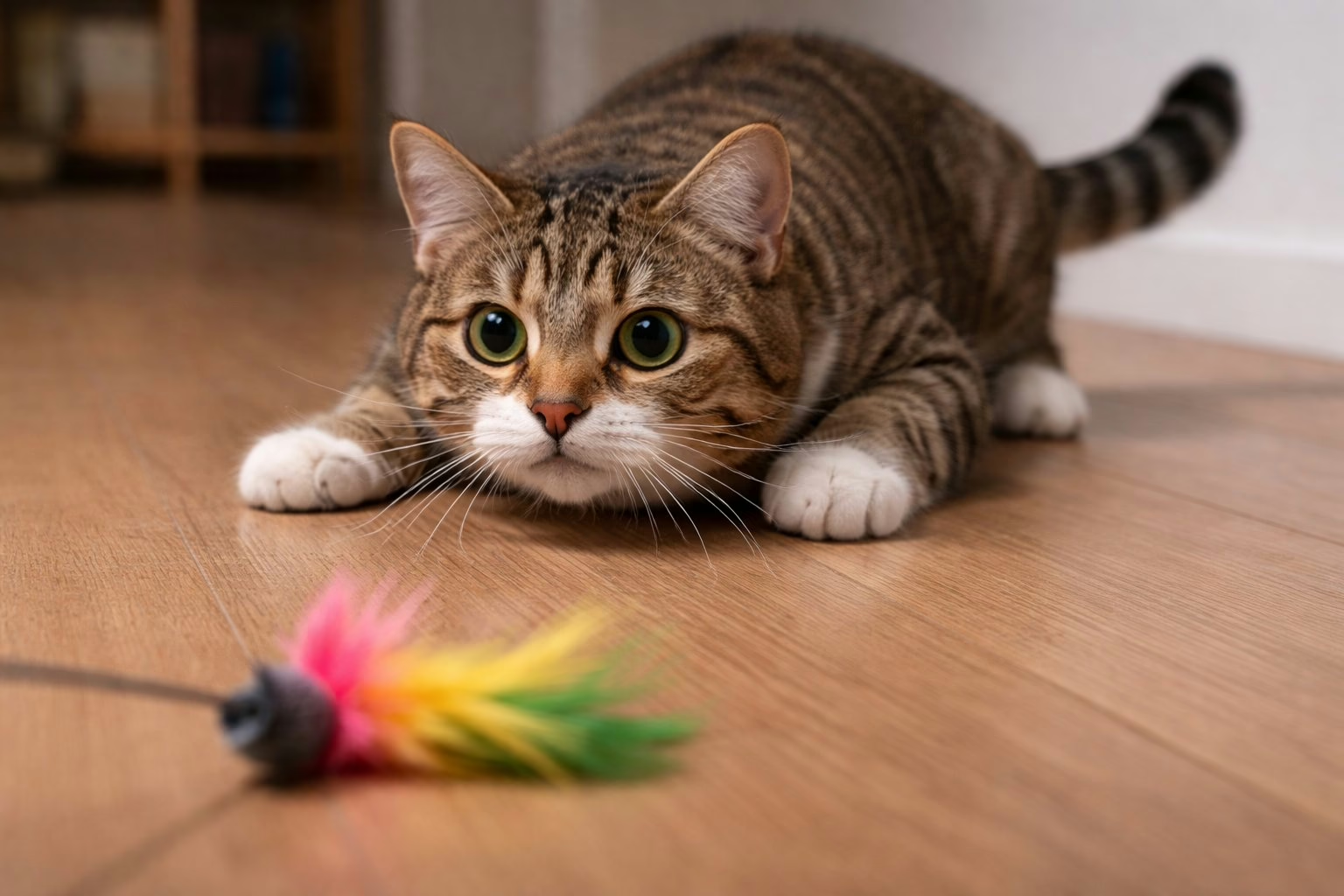
Myth: Cats see only in black and white. False. Cats have dichromatic color vision that includes blues and yellows, though reds and greens cause problems. Their color range is definitely more muted than human trichromatic vision, but they absolutely distinguish certain colors. This myth probably persists because cats don’t react strongly to color changes in toys—brightness and movement matter far more for triggering prey drive than color does.
Myth: Cats see better than humans during daytime. Actually reversed. Human vision surpasses feline vision when the sun’s up. Our greater cone concentration and superior visual acuity mean we see colors, details, and distant objects more clearly in bright conditions. Cats actually squint and seek shade during peak daylight—their eyes are tuned for dim conditions. That vertical slit pupil helps manage bright light but can’t fully compensate for retinas loaded with rods instead of cones.
Myth: Cats can see ultraviolet light. Some research suggests cats might detect near-UV wavelengths invisible to humans, but this remains debated. Even if true, UV vision would offer minimal hunting advantage since most prey doesn’t reflect UV light in distinctive patterns.
Myth: Older cats lose their night vision first. Not typically. Aging cats usually experience decreased visual acuity across all lighting conditions rather than specific night vision deterioration. Age-related changes affect the lens and retina broadly, not just the specialized structures handling low-light vision.
Cat Vision vs. Human Vision: Key Differences
| Visual Feature | How Cats See | How Humans See |
|---|---|---|
| Total Field of View | Approximately 200 degrees | Approximately 180 degrees |
| Low-Light Performance | Function with 1/6th the light humans need | Baseline comparison point |
| Color Perception | Dichromatic—blues and yellows primarily | Trichromatic—full visible spectrum |
| Detail Sharpness | 20/100 to 20/200 equivalent | 20/20 standard baseline |
| Optimal Focus Range | 2-6 feet from face | 10-20 feet from face |
| Movement Detection | Superior, particularly in periphery | Moderate capability |
| Required Light Threshold | Around 0.125 lux | Around 0.75 lux |
According to Dr. Sarah Williams, a veterinary ophthalmologist at Cornell University:
Cats traded away color richness and visual sharpness in exchange for successful hunting during dawn and dusk hours—the specific time window where their evolutionary adaptations shine.
Dr. Sarah Williams
FAQs
Not even close. Cats require some minimal light for vision to work. The tapetum lucidum and rod-packed retina amplify whatever light exists, but they can’t manufacture visual information from nothing. In genuine total darkness, cats navigate using whiskers, acute hearing, and excellent spatial memory instead of sight.
Cats have restricted color vision rather than complete colorblindness. They see blues and yellows fairly well but perceive reds, greens, and oranges as variations of gray, yellow, or bluish tones. This dichromatic vision resembles human red-green colorblindness. The limited color palette doesn’t hurt hunting effectiveness since detecting prey depends mainly on movement patterns and contrast rather than color.
That glow comes from the tapetum lucidum—the reflective layer positioned behind the retina. It bounces incoming light back out through the pupil after photoreceptors get their second chance to capture it. This reflected light creates eyeshine. The glow color (green, gold, orange, or sometimes blue) varies by individual based on mineral composition in the tapetum layer. Siamese cats and blue-eyed white cats often show red or ruby eyeshine because they lack a functioning tapetum lucidum.
Maximum clarity occurs between 2-6 feet away—their ideal pouncing distance. Past 20 feet, substantial blurring occurs, though movement detection remains effective out to 50-60 feet. Objects closer than 12 inches become tough to focus on, which explains why cats rely on whiskers and smell when investigating items very close to their face.
If you’re standing 10-15 feet from your cat, yes—you appear somewhat blurred compared to how sharply you see yourself in a mirror. Cats recognize humans primarily through characteristic movement patterns, voice recognition, and scent memory rather than fine facial detail analysis. At typical interaction distances of 3-6 feet, cats see sufficient detail to recognize familiar people, just not with the razor-sharp clarity humans experience.
Modern cats perceive images on newer televisions much better than previous generations did with old CRT technology. Older televisions refreshed at 60Hz, which looked like annoying flicker to cats whose visual systems detect flicker rates up to about 100Hz. Current LED and OLED displays refresh at 120Hz or higher, appearing as smooth, continuous motion to feline eyes. That said, cats may not interpret TV images as meaningful since they lack proper depth cues and natural movement patterns characteristic of real prey. Some cats show interest in nature documentaries featuring birds or small mammals, while others completely ignore screens.
Feline vision represents millions of years of fine-tuning for a highly specific ecological niche: ambush hunting of small prey during twilight hours. The anatomical trade-offs—swapping color variety and fine detail for motion sensitivity and low-light capability—make complete sense for predators most active at dawn and dusk.
Recognizing these visual differences helps you make smarter decisions as a cat owner. Toys in blue and yellow shades stand out better to cats than red ones do. Interactive play that mimics natural prey movement patterns engages hunting instincts more effectively than stationary objects ever could. Providing clear sight lines to windows satisfies their instinct to monitor territory for movement.
Next time your cat fixates intensely on what appears to be an empty corner or suddenly pounces on seemingly invisible prey, remember they’re detecting subtle movements and processing different visual information than you are. They’re not hallucinating—they’re experiencing the environment through sensory equipment fundamentally different from yours, perfectly calibrated for the hunting lifestyle that kept their ancestors fed across evolutionary time scales.